
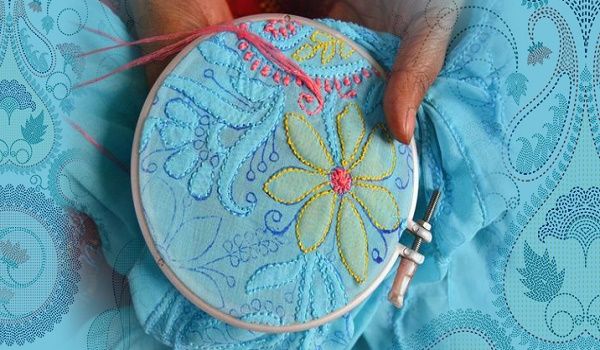
Image Credit: https://kraftly.com/blog/mesmerizing-art-chikankari/
Chikankari is a very delicate and intricate shadow work type of embroidery. Initially, the embroidery was done using white yarn, on colorless muslins known as tanzeb. However, today, georgette, chiffon, cotton and other fine fabrics are also being used. From being an embellishment used primarily for decorating clothes, Chikankari embroidery work of India has now spread to cushion covers, pillow covers, table linen and so on.
There are different explanations behind the evolution of the term Chikankari. As per one version, the word Chikankari has been derived from a Persian word Chakin or Chakeen, which means creating delicate patterns on a fabric. According to others, it may be a distorted version of Chikeen or Siquin, a coin valuing Rs 4 for which the work was sold. Yet another explanation ascribes the term to the East Bengal language, in which Chikan meant fine.
History of Chikankari
We find references to Indian Chikan work as early as the 3rd century BC. Megasthenes, a Greek traveler, has mentioned the use of flowered muslins by Indians. There are different versions as to the origin of Chikankari embroidery work in India. It is said that a traveler, who was passing through a village in Lucknow, stopped and requested a poor peasant for water. Delighted at the hospitality of the peasant, the traveler taught him the art of Chikankari, which would ensure that he would never remain hungry in life. Lucknow city is the most renowned place for Chikankari work. Another explanation credits Noorjahan, the queen of Emperor Jahangir, with the introduction of the Chikankari embroidery work in India.
Method of Chikankari Embroidery Work
The stitches used in Chikan Kari work of Lucknow are basically of three categories, namely
- Flat Stitches (Subtle stitches that remain close to the fabric)
- Embossed Stitches (they give a grainy appearance)
- Jali Work (Created by thread tension, it gives a delicate net effect)
Indian Chikan work basically consists of a number of processes, namely cutting, stitching, printing, embroidery, washing and finishing. Cutting and stitching are done by the same person. Then, printing is undertaken with wooden blocks dipped in dye. After this, embroidery is done, usually by women. The last step in the Chikankari embroidery work is washing and finishing, which may take from 10 to 12 days and involves bleaching, acid treatment, stiffening and ironing. The most common motif used in Chikan Kari work of Lucknow is that of creepers. Floral motifs, which are used either throughout the garment or in corners, include jasmine, rose, flowering stems, lotus, etc.