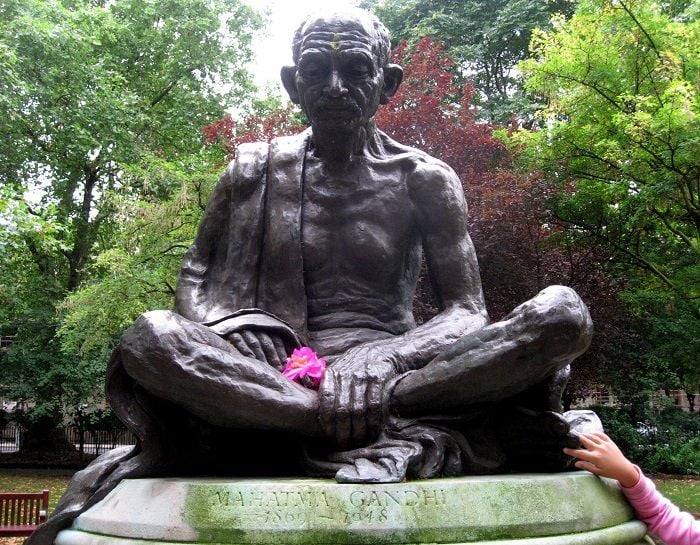
Fast Facts
Date of Birth: October 2, 1869
Place of Birth: Porbandar, British India (now Gujarat)
Date of Death: January 30, 1948
Place of Death: Delhi, India
Cause of Death: Assassination
Professions: Lawyer, politician, activist, writer
Spouse: Kasturba Gandhi
Children: Harilal Gandhi, Manilal Gandhi, Ramdas Gandhi and Devdas Gandhi
Father: Karamchand Uttamchand Gandhi
Mother: Putlibai Gandhi
Mohandas Karamchand Gandhi was an eminent freedom activist and an influential political leader who played a dominant role in India's struggle for independence. Gandhi is known by different names, such as Mahatma (a great soul), Bapuji (endearment for father in Gujarati) and Father of the Nation. Every year, his birthday is celebrated as Gandhi Jayanti, a national holiday in India, and also observed as the International Day of Nonviolence. Mahatma Gandhi, as he is most commonly referred to, was instrumental in liberating India from the clutches of the British. With his unusual yet powerful political tools of Satyagraha and non-violence, he inspired several other political leaders all over the world including the likes of Nelson Mandela, Martin Luther King Jr and Aung San Suu Kyi. Gandhi, apart from helping India triumph in its fight for independence against the English, also led a simple and righteous life, for which he is often revered. Gandhi's early life was pretty much ordinary, and he became a great man during the course of his life. This is one of the main reasons why Gandhi is followed by millions, for he proved that one can become a great soul during the course of one’s life, should they possess the will to do so.
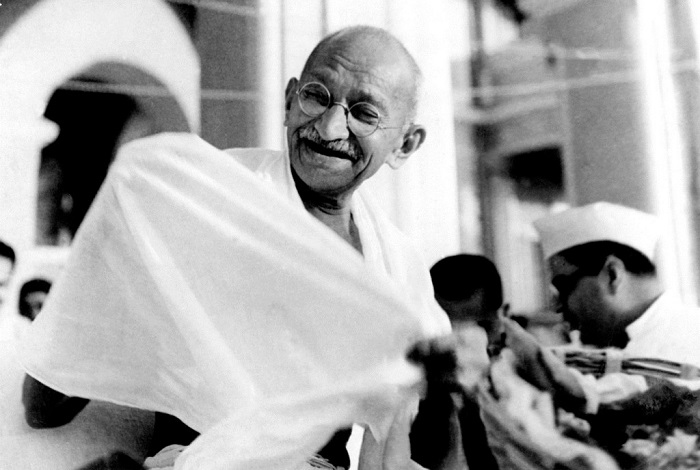
Childhood
M. K. Gandhi was born in the princely state of Porbandar, which is located in modern-day Gujarat. He was born into a Hindu merchant caste family to Karamchand Gandhi, diwan of Porbandar and his fourth wife, Putlibai. Gandhi’s mother belonged to an affluent Pranami Vaishnava family. As a child, Gandhi was a very naughty and mischievous kid. In fact, his sister Raliat had once revealed that hurting dogs by twisting their ears was among Maohandas’ favorite pastime. During the course of his childhood, Gandhi befriended Sheikh Mehtab, who was introduced to him by his older brother. Gandhi, who was raised by a vegetarian family, started eating meat. It is also said that a young Gandhi accompanied Sheikh to a brothel, but left the place after finding it uncomfortable. Gandhi, along with one of his relatives, also cultivated the habit of smoking after watching his uncle smoke. After smoking the leftover cigarettes, thrown away by his uncle, Gandhi started stealing copper coins from his servants in order to buy Indian cigarettes. When he could no longer steal, he even decided to commit suicide such was Gandhi’s addiction to cigarettes. At the age of fifteen, after stealing a bit of gold from his friend Sheikh’s armlet, Gandhi felt remorseful and confessed to his father about his stealing habit and vowed to him that he would never commit such mistakes again.
Early Life
In his early years, Gandhi was deeply influenced by the stories of Shravana and Harishchandra that reflected the importance of truth. Through these stories and from his personal experiences, he realized that truth and love are among the supreme values. Mohandas married Kasturba Makhanji at the age of 13. Gandhi later went on to reveal that the marriage didn’t mean anything to him at that age and that he was happy and excited only about wearing new set of clothes. But then as days passed by, his feelings for her turned lustful, which he later confessed with regret in his autobiography. Gandhi had also confessed that he could no more concentrate in school because of his mind wavering towards his new and young wife.
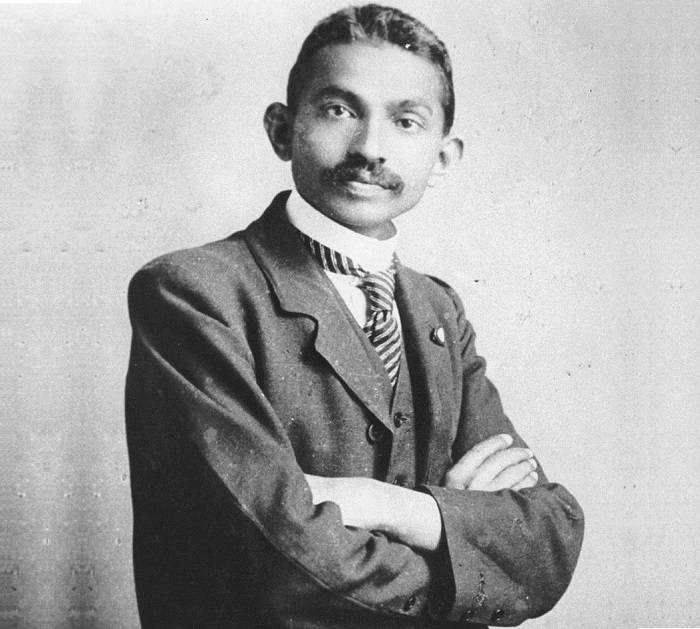
Education
After his family moved to Rajkot, a nine year old Gandhi was enrolled at a local school, where he studied the basics of arithmetic, history, geography and languages. When he was 11 years old, he attended a high school in Rajkot. He lost an academic year in between because of his wedding but later rejoined the school and eventually completed his schooling. He then dropped out of Samaldas College in Bhavnagar State after joining it in the year 1888. Later Gandhi was advised by a family friend Mavji Dave Joshiji to pursue law in London. Excited by the idea, Gandhi managed to convince his mother and wife by vowing before them that he would abstain from eating meat and from having sex in London. Supported by his brother, Gandhi left to London and attended the Inner Temple and practiced law. During his stay in London, Gandhi joined a Vegetarian Society and was soon introduced to Bhagavad Gita by some of his vegetarian friends. The contents of Bhagavad Gita would later have a massive influence on his life. He came back to India after being called to the bar by Inner Temple.
Gandhi in South Africa
After returning to India, Gandhi struggled to find work as a lawyer. In 1893, Dada Abdullah, a merchant who owned a shipping business in South Africa asked if he would be interested to serve as his cousin’s lawyer in South Africa. Gandhi gladly accepted the offer and left to South Africa, which would serve as a turning point in his political career.
In South Africa, he faced racial discrimination directed towards blacks and Indians. He faced humiliation on many occasions but made up his mind to fight for his rights. This turned him into an activist and he took upon him many cases that would benefit the Indians and other minorities living in South Africa. Indians were not allowed to vote or walk on footpaths as those privileges were limited strictly to the Europeans. Gandhi questioned this unfair treatment and eventually managed to establish an organization named ‘Natal Indian Congress’ in 1894. After he came across an ancient Indian literature known as ‘Tirukkural’, which was originally written in Tamil and later translated into many languages, Gandhi was influenced by the idea of Satyagraha (devotion to the truth) and implemented non-violent protests around 1906. After spending 21 years in South Africa, where he fought for civil rights, he had transformed into a new person and he returned to India in 1915.
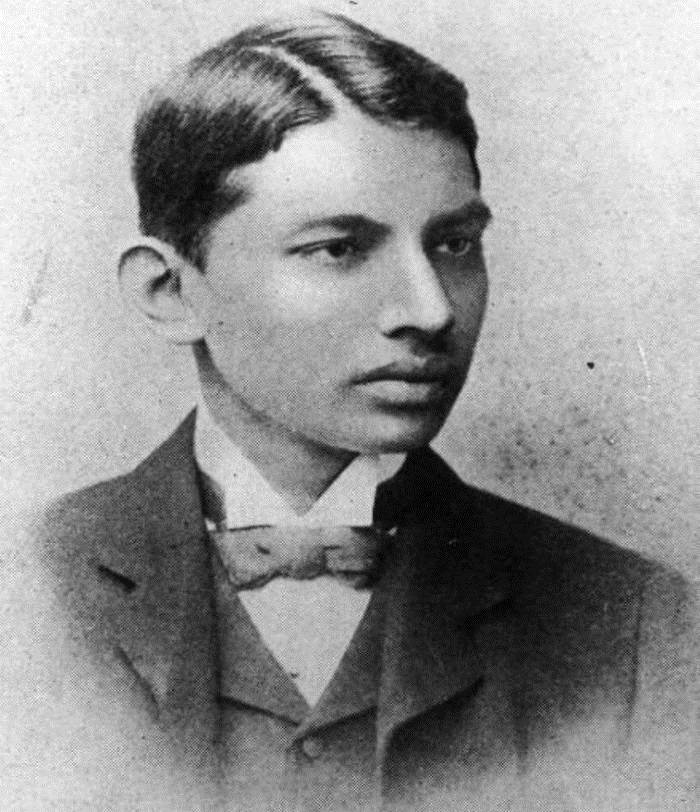
Gandhi and the Indian National Congress
After his long stay in South Africa and his activism against the racist policy of the British, Gandhi had earned the reputation as a nationalist, theorist and organiser. Gopal Krishna Gokhale, a senior leader of the Indian National Congress, invited Gandhi to join India’s struggle for independence against the British Rule. Gokhale thoroughly guided Mohandas Karamchand Gandhi about the prevailing political situation in India and also the social issues of the time. He then joined the Indian National Congress and before taking over the leadership in 1920, headed many agitations which he named Satyagraha.
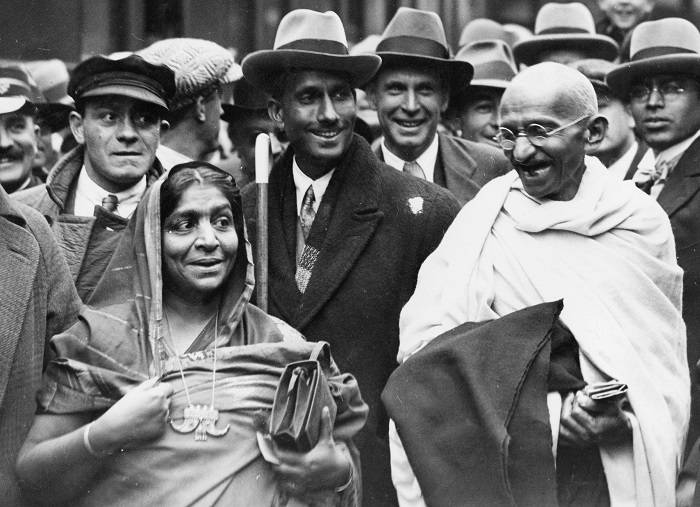
Image source: https://www.pinterest.com/pin/17029304817074165/
Champaran Satyagraha
The Champaran agitation in 1917 was the first major success of Gandhi after his arrival in India. The peasants of the area were forced by the British landlords to grow Indigo, which was a cash crop, but its demand had been declining. To make the matters worse, they were forced to sell their crops to the planters at a fixed price. The farmers turned to Gandhiji for help. Pursuing a strategy of nonviolent agitation, Gandhi took the administration by surprise and was successful in getting concessions from the authorities. This campaign marked Gandhi’s arrival in India!
Kheda Satyagraha
Farmers asked the British to relax the payment of taxes as Kheda was hit by floods in 1918. When the British failed to pay heed to the requests, Gandhi took the case of the farmers and led the protests. He instructed them to refrain from paying revenues no matter what. Later, the British gave in and accepted to relax the revenue collection and gave its word to Vallabhbhai Patel, who had represented the farmers.
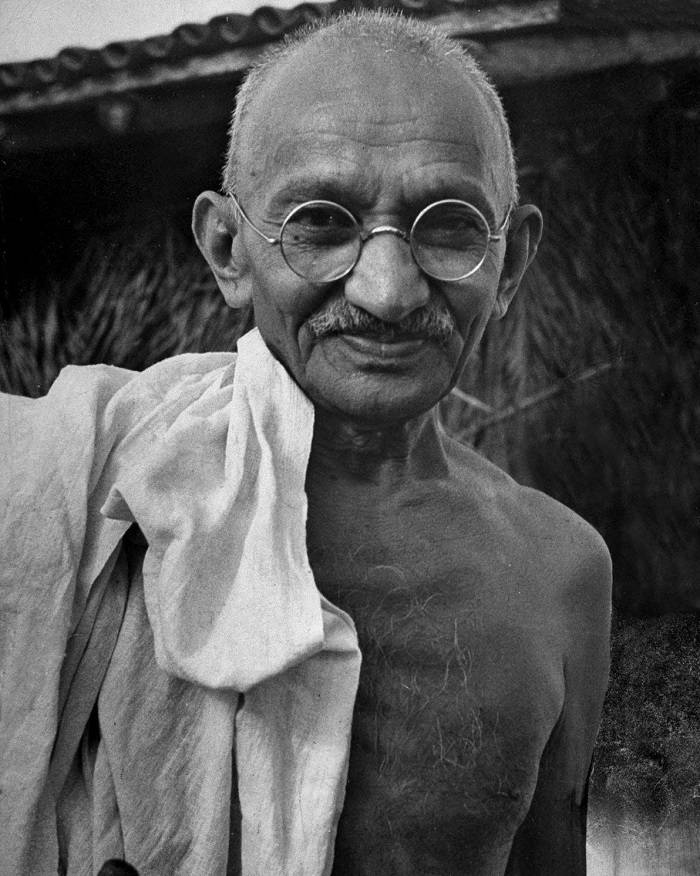
Image source: YouTube.com
Khilafat Movement Post World War I
Gandhi had agreed to support the British during their fight in World War I. But the British failed to grant independence post the war, as promised earlier, and as a result of this Khilafat Movement was launched. Gandhi realized that Hindus and Muslims must unite to fight the British and urged both the communities to show solidarity and unity. But his move was questioned by many Hindu leaders. Despite the opposition from many leaders, Gandhi managed to amass the support of Muslims. But as the Khilafat Movement ended abruptly, all his efforts evaporated into thin air.
Non-cooperation Movement and Gandhi
Non-cooperation Movement was one of Gandhi’s most important movements against the British. Gandhi’s urged his fellow countrymen to stop co-operation with the British. He believed that the British succeeded in India only because of the co-operation of the Indians. He had cautioned the British not to pass the Rowlatt Act, but they did not pay any attention to his words and passed the Act. As announced, Gandhiji asked everyone to start civil disobedience against the British. The British began suppressing the civil disobedience movement by force and opened fire on a peaceful crowd in Delhi. The British asked Gandhiji to not enter Delhi which he defied as a result of which he was arrested and this further enraged people and they rioted. He urged people to show unity, non-violence and respect for human life. But the British responded aggressively to this and arrested many protesters.
On 13 April 1919, a British officer, Dyer, ordered his forces to open fire on a peaceful gathering, including women and children, in Amritsar’s Jallianwala Bagh. As a result of this, hundreds of innocent Hindu and Sikh civilians were killed. The incident is known as ‘Jallianwala Bagh Massacre’. But Gandhi criticized the protesters instead of blaming the English and asked Indians to use love while dealing with the hatred of British. He urged the Indians to refrain from all kinds of non-violence and went on fast-to-death to pressure Indians to stop their rioting.
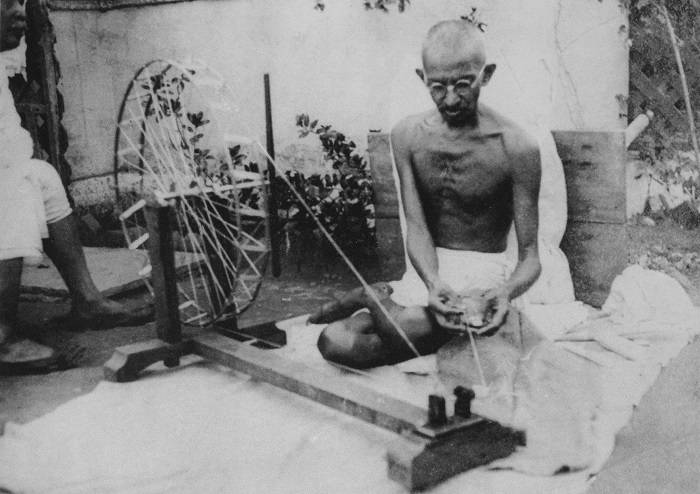
Image source: Wikimedia.org
Swaraj
The concept of non-cooperation became very popular and started spreading through the length and breadth of India. Gandhi extended this movement and focused on Swaraj. He urged people to stop using British goods. He also asked people to resign from government employment, quit studying in British institutions and stop practicing in law courts. However, the violent clash in Chauri Chaura town of Uttar Pradesh, in February 1922, forced Gandhiji to call-off the movement all of a sudden. Gandhi was arrested on 10th March 1922 and was tried for sedition. He was sentenced to six years imprisonment, but served only two years in prison.
Simon Commission & Salt Satyagraha (Dandi March)
During the period of 1920s, Mahatma Gandhi concentrated on resolving the wedge between the Swaraj Party and the Indian National Congress. In 1927, British had appointed Sir John Simon as the head of a new constitutional reform commission, popularly known as ‘Simon Commission’. There was not even a single Indian in the commission. Agitated by this, Gandhi passed a resolution at the Calcutta Congress in December 1928, calling on the British government to grant India dominion status. In case of non-compliance with this demand, the British were to face a new campaign of non-violence, having its goal as complete independence for the country. The resolution was rejected by the British. The flag of India was unfurled by the Indian national Congress on 31st December 1929 at its Lahore session. January 26, 1930 was celebrated as the Independence Day of India.
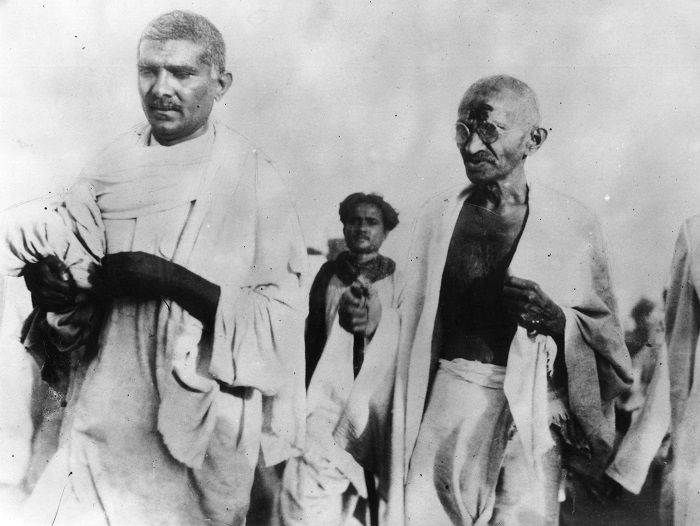
But the British failed to recognize it and soon they levied a tax on salt and Salt Satyagraha was launched in March 1930, as an opposition to this move. Gandhi started the Dandi March with his followers in March, going from Ahmedabad to Dandi on foot. The protest was successful and resulted in the Gandhi-Irwin Pact in March 1931.
Negotiations over Round Table Conferences
Post the Gandhi-Irwin Pact, Gandhi was invited to round table conferences by the British. While Gandhi pressed for the Indian independence, British questioned Gandhi’s motives and asked him not to speak for the entire nation. They invited many religious leaders and B. R. Ambedkar to represent the untouchables. The British promised many rights to various religious groups as well as the untouchables. Fearing this move would divide India further, Gandhi protested against this by fasting. After learning about the true intentions of the British during the second conference, he came up with another Satyagraha, for which he was once again arrested.
Quit India Movement
As the World War II progressed, Mahatma Gandhi intensified his protests for the complete independence of India. He drafted a resolution calling for the British to Quit India. The 'Quit India Movement' or the 'Bharat Chhodo Andolan' was the most aggressive movement launched by the Indian national Congrees under the leadership of Mahatma Gandhi. Gandhi was arrested on 9th August 1942 and was held for two years in the Aga Khan Palace in Pune, where he lost his secretary, Mahadev Desai and his wife, Kasturba. The Quit India Movement came to an end by the end of 1943, when the British gave hints that complete power would be transferred to the people of India. Gandhi called off the movement which resulted in the release of 100,000 political prisoners.
Freedom and Partition of India
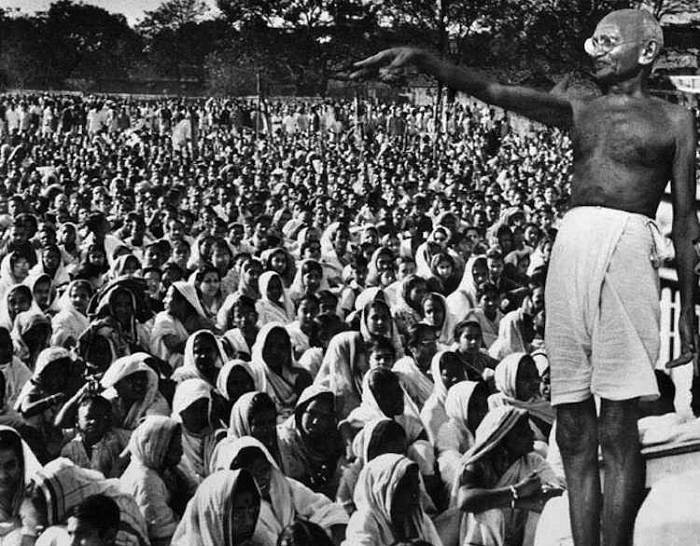
The independence cum partition proposal offered by the British Cabinet Mission in 1946 was accepted by the Congress, despite being advised otherwise by Mahatma Gandhi. Sardar Patel convinced Gandhi that it was the only way to avoid civil war and he reluctantly gave his consent. After India's independence, Gandhi focused on peace and unity of Hindus and Muslims. He launched his last fast-unto-death in Delhi, and asked people to stop communal violence and emphasized that the payment of Rs. 55 crores, as per the Partition Council agreement, be made to Pakistan. Ultimately, all political leaders conceded to his wishes and he broke his fast.
Assassination of Mahatma Gandhi
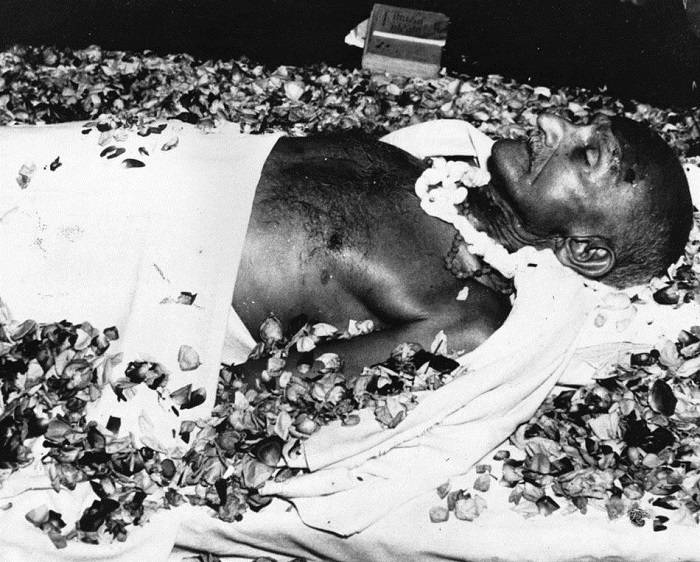
The inspiring life of Mahatma Gandhi came to an end on 30th January 1948, when he was shot by a fanatic, Nathuram Godse, at point-blank range. Nathuram was a Hindu radical, who held Gandhi responsible for weakening India by ensuring the partition payment to Pakistan. Godse and his co-conspirator, Narayan Apte, were later tried and convicted. They were executed on 15th November 1949.
Mahatma Gandhi’s Legacy
Mahatma Gandhi proposed the acceptance and practice of truth, peace, non-violence, vegetarianism, Brahmacharya (celibacy), simplicity and faith in God. Though he would be remembered forever for his great contribution to the Indian freedom movement, his greatest legacies are the tools of peace and non-iolence that he preached and used in India's struggle for freedom against the British. He was for peace and non-violence all over the world, as he truly believed that only these virtues can save the mankind. Mahatma Gandhi once wrote a letter to Hitler, before the World War II, pleading him to avoid war. These methods inspired several other world leaders in their struggle against injustice. His statues are installed all over the world and he is considered the most prominent personality in Indian history.
Gandhi in Popular Culture
The word Mahatma is often mistaken in the West as Gandhi’s first name. His extraordinary life inspired innumerable works of art in the field of literature, art and showbiz. Many movies and documentaries have been made on the life of the Mahatma. Post the Independence, Gandhi’s image became the mainstay of Indian paper currency.
Source: Mahatma Gandhi Quotes @ FamousQuotes123