
Title: Devanam Priyadarshi
Birth: 304 B.C.
Birthplace: Pataliputra (modern day Patna)
Dynasty: Maurya
Parents: Bindusara and Devi Dharma
Reign: 268 –232 B.C.
Symbol: Lion
Religion: Buddhism
Spouse: Asandhimitra, Devi, Karuvaki, Padmavati, Tishyaraksha
Children: Mahendra, Sanghamitra, Tivala, Kunala, Charumati
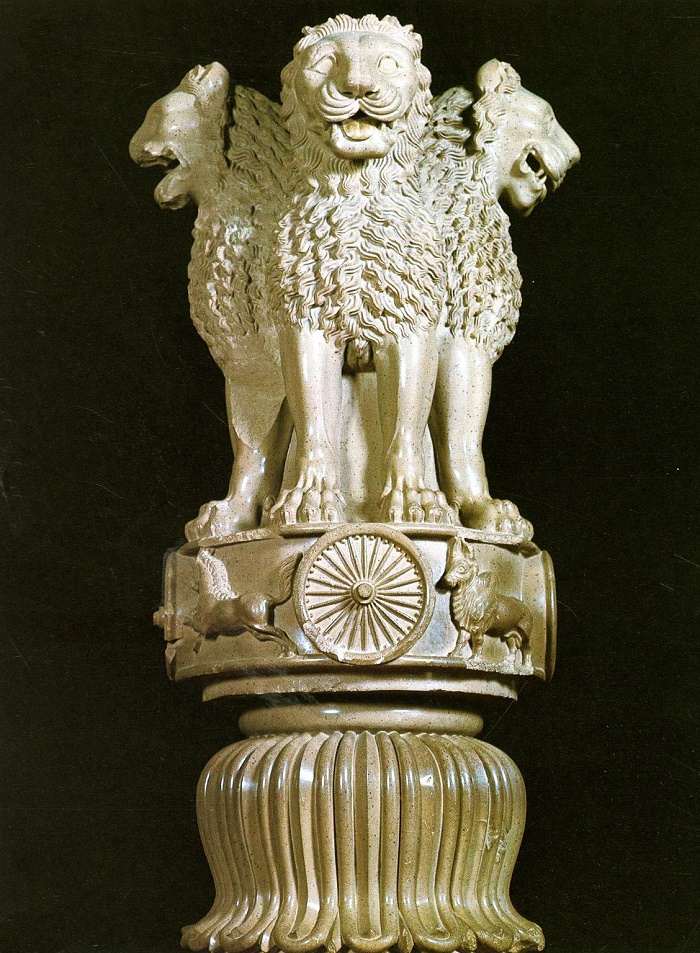
Ashoka was the third ruler of the illustrious Maurya dynasty and was one of the most powerful kings of the Indian subcontinent in ancient times. His reign between 273 BC and 232 B.C. was one of the most prosperous periods in the history of India. Ashoka’s empire consisted most of India, South Asia and beyond, stretching from present day Afghanistan and parts of Persia in the west, to Bengal and Assam in the east, and Mysore in the south. Buddhist literature document Ashoka as a cruel and ruthless monarch who underwent a change of heart after experiencing a particularly gruesome war, the Battle of Kalinga. After the war, he embraced Buddhism and dedicated his life towards dissemination of the tenets of the religion. He became a benevolent king, driving his administration to make a just and bountiful environment for his subjects. Owing to his benevolent nature as a ruler, he was given the title ‘Devanampriya Priyadarshi’. Ashoka and his glorious rule is associated with one of the most prosperous time in the history of India and as a tribute to his non-partisan philosophies, the Dharma Chakra adorning the Ashok stambh has been made a part of the Indian National Flag. The emblem of the Republic of India has been adapted from the Lion Capital of Ashoka.
Early Life
Ashoka was born to Mauryan King Bindusara and his queen Devi Dharma in 304 B.C. He was the grandson of the great Chandragupta Maurya, the founder emperor of the Maurya Dynasty. Dharma (alternatively known as Subhadrangi or Janapadkalyani) was the daughter of a Brahmin priest from the kindom of Champa, and was assigned relatively low position in the royal household owing to politics therein. By virtue of his mother’s position, Ashoka also received a low position among the princes. He had only one younger sibling, Vithashoka, but, several elder half-brothers. Right from his childhood days Ashoka showed great promise in the field of weaponry skills as well as academics. Ashoka’s father Bindusara, impressed with his skill and knowledge, appointed him as the Governer of Avanti. Here he met and married Devi, the daughter of a tradesman from Vidisha. Ashoka and Devi had two children, son Mahendra and daughter Sanghamitra.
Asoka quickly grew into an excellent warrior general and an astute statesman. His command on the Mauryan army started growing day by day. Ashoka’s elder brothers became jealous of him and they assumed him being favoured by King Bindusara as his successor to the throne. King Bindusara’s eldest son Sushima convinced his father to send Ashoka far away from the capital city of Pataliputra to Takshashila province. The excuse given was to subdue a revolt by the citizens of Takshashila. However, the moment Ashoka reached the province, the militias welcomed him with open arms and the uprising came to an end without any fight. This particular success of Asoka made his elder brothers, especially Susima, more insecure.
Accession to the Throne
Susima started inciting Bindusara against Ashoka, who was then sent into exile by the emperor. Ashoka went to Kalinga, where he met a fisherwoman named Kaurwaki. He fell in love with her and later, made Kaurwaki his second or third wife. Soon, the province of Ujjain started witnessing a violent uprising. Emperor Bindusara called back Ashoka from exile and sent him to Ujjain. The prince was injured in the ensuing battle and was treated by Buddhist monks and nuns. It was in Ujjain that Asoka first came to know about the life and teachings of Buddha.
In the following year, Bindusura became seriously ill and was literally on his deathbed. Sushima was nominated successor by the king but his autocratic nature made him unfavourable among the ministers. A group of ministers, led by Radhagupta, called upon Ashoka to assume the crown. Following Bindusara’s death in 272 B.C., Ashoka attacked Pataliputra, defeated and killed all his brothers, including Sushima. Among all his brothers he only spared his younger brother Vithashoka. His coronation took place four years after his ascent to throne. Buddhist literatures describe Ashoka as a cruel, ruthless and bad-tempered ruler. He was named ‘Chanda’ Ashoka meaning Ashoka the Terrible, due to his disposition at that time. He was attributed with building Ashoka’s Hell, a torture chamber manned by an executioner to punish offenders.
After he became the empperor, Ashoka launched brutal assaults to expand his empire, which lasted for around eight years. Although the Maurya Empire that he inherited was quite sizable, he expanded the borders exponentially. His kingdom stretched from Iran-Afghanistan borders in the West to Burma in the east. He annexed the whole of Southern India except Ceylon (modern day Sri Lanka). The only kingdom outside his grasp was Kalinga which is the modern day Orissa.
The Battle of Kalinga and Submission to Buddhism
Ashoka launched an assault to conquer Kalinga during 265 B.C. and the battle of Kalinga became a turning point in his life. Ashoka personally led the conquest and secured victory. On his orders, the whole of province was plundered, cities were destroyed and thousands of people were killed.
The morning after the victory he went out to survey the states of things and encountered nothing except burnt houses and scattered corpses. Having brought face to face with the consequences of war, for the first time he felt overwhelmed with the brutality of his actions. He saw flashes of the destruction that his conquest had wrought even after returning to Pataliputra. He experienced an utter crisis of faith during this period and sought penance for his past deeds. He vowed never to practice violence again and devoted himself completely to Buddhism. He followed the directives of Brahmin Buddhist gurus Radhaswami and Manjushri and started propagating Buddhist principles throughout his kingdom. Thus Chandashoka morphed into Dharmashoka or the pious Ashoka.
Administration of Ashoka
The administration of Ashoka after his spiritual transformation was focused solely on the well-being of his subjects. The emperor was at the helm of the administration following the established model put forward by Mauryan Kings before Ashoka. He was closely assisted in his administrative duties by his younger brother, Vithashoka and a group of trusted ministers, whom Ashoka consulted before adopting any new administrative policy. The most important members of this advisory council included the Yuvaraj (Crown Prince), the Mahamantri (Prime Minister), the Senapati (general), and the Purohita (priest). Asoka’s reign saw introduction of a large number of benevolent policies as compared to his predecessors. He adopted a paternalistic view on administration and proclaimed "All men are my Children", as evident from the Kalinga edict. He also expressed his indebtedness to his subjects for bestowing with their love and respect, and that he considered it his duty to serve for their greater good.
His kingdom was divided into Pradesha or provinces which were subdivided into Vishyas or subdivisions and Janapadas, which were further subdivided into villages.The five chief provinces under Ashoka’s reign were the Uttarapatha(Northern Province) with its capital at Taxila; Avantiratha (western province) with its headquarters at Ujjain; Prachyapatha (eastern province) with its centre at Toshali and the Dakshinapatha (southern province) with its capital as Suvarnagiri. The central province, Magadha with its capital at Pataliputra was the administrative centre of the empire. Each province was granted partial autonomy at the hand of a crown prince who was responsible for controlling the overall law enforcement, but the emperor himself retained much of the financial and administrative controls. These provincial heads were altered from time to time to prevent any one of them exerting power over a long period of time. He appointed several Pativedakas or reporters, who would report to him the general and public affairs, leading the king to take necessary steps.
Although Ashoka built his empire on the principles of non-violence, he followed the instructions outlined in the Arthashastra for the characters of the Perfect King. He introduced legal reforms like Danda Samahara and Vyavahara Samahara, clearly pointing out to his subjects the way of life that is to be led by them. The overall judicial and administration were overseen by Amatyas or civil servants whose functions were clearly delineated by the Emperor. The Akshapataladhyaksha was in charge of currency and accounts of the entire administration. The Akaradhyaksha was in-charge of mining and other metallurgical endeavours. The Sulkadhyaksa was in charge of collecting the taxes. The Panyadhyaksha was controller of commerce. The Sitadhyaksha was in charge of agriculture. The emperor employed a network of spies who offered him tactical advantages in diplomatic matters. The administration conducted regular census along with other information as caste and occupation.
Religious Policy: Ashoka’s Dhamma
Ashoka made Buddhism the state religion around 260 B.C. He was perhaps the first emperor in history of India who tried to establish a Buddhist polity by implementing the Dasa Raja Dharma or the ten precepts outlined by Lord Buddha himself as the duty of a perfect ruler. They are enumerated as:
1.To be liberal and avoid selfishness
2. To maintain a high moral character
3. To be prepared to sacrifice one's own pleasure for the well-being of the subjects
4. To be honest and maintain absolute integrity
5. To be kind and gentle
6. To lead a simple life for the subjects to emulate
7. To be free from hatred of any kind
8. To exercise non-violence
9. To practice patience
10. To respect public opinion to promote peace and harmony
Based on these 10 principles preached by Lord Buddha, Ashoka dictated the practice of Dharma that became the backbone of his philanthropic and tolerant administration. Dharma was neither a new religion nor a new political philosophy. It was a way of life, outlined in a code of conduct and a set of principles that he encouraged his subjects to adopt to lead a peaceful and prosperous life. He undertook the propagation of these philosophies through publication of 14 edicts that he spread out throughout his empire.
Ashoka’s Edicts:
1. No living being were to be slaughtered or sacrificed.
2. Medical care for human as well as animals throughout his Empire
3. Monks to tour the empire every five years teaching the principles of dharma to the common people.
4. One should always respect one’s parents, priests and monks
5. Prisoners to be treated humanely
6. He encouraged his subjects to report to him their concerns regarding the welfare of the administration at all times no matter where he is or what he is doing.
7. He welcomed all religions as they desire self-control and purity of heart.
8. He encouraged his subjects to give to monks, Brahmans and to the needy.
9. Reverence for the dharma and a proper attitude towards teachers was considered better than marriage or other worldly celebrations, by the Emperor.
10. Emperor surmised that glory and fame count for nothing if people do not respect the dharma.
11. He considered giving the dharma to others is the best gift anyone can have.
12. Whoever praises his own religion, due to excessive devotion, and condemns others with the thought "Let me glorify my own religion," only harms his own religion. Therefore contact (between religions) is good.
13. Ashoka preached that conquest by the dhamma is superior to conquest by force but if conquest by force is carried out, it should be 'forbearance and light punishment'.
14. The 14 edicts were written so that people might act in accordance with them.
He got these 14 edicts engraved in stone pillars and slabs and had them placed at strategic places around his kingdom.
Role in Dissemination of Buddhism
Throughout his life, 'Asoka the Great' followed the policy of non-violence or ahimsa. Even the slaughter or mutilation of animals was abolished in his kingdom. He promoted the concept of vegetarianism. The caste system ceased to exist in his eyes and he treated all his subjects as equals. At the same time, each and every person was given the rights to freedom, tolerance, and equality.
The third council of Buddhism was held under the patronage of Emperor Ashoka. He also supported the Vibhajjavada sub-school of the Sthaviravada sect, now known as the Pali Theravada.
He sent missionaries to far of places to propagate the ideals of Buddhism and inspire people to live by the teachings of Lord Buddha. He even engaged members of the royal family, including his son and daughter, Mahendra and Sanghamitra, to carry out duties of Buddhist missionaries. His missionaries went to the below mentioned places - Seleucid Empire (Middle Asia), Egypt, Macedonia, Cyrene (Libya), and Epirus (Greece and Albania). He also sent dignitaries all over his empire to propagate his ideals of Dhamma based on Buddhist philosophy. Some of these are listed as follows:
- Kashmir - Gandhara Majjhantika
- Mahisamandala (Mysore) - Mahadeva
- Vanavasi (Tamil Nadu) - Rakkhita
- Aparantaka (Gujarat and Sindh) - Yona Dhammarakkhita
- Maharattha (Maharashtra) - Mahadhammarakkhita
- "Country of the Yona" (Bactria/ Seleucid Empire) - Maharakkhita
- Himavanta (Nepal) - Majjhima
- Suvannabhumi (Thailand/ Myanmar) - Sona and Uttara
- Lankadipa (Sri Lanka) - Mahamahinda
Demise
After ruling over the Indian subcontinent for a period of approximately 40 years, the Great Emperor Asoka left for the holy abode in 232 BC. After his death, his empire lasted just fifty more years.
Ashoka’s Legacy
Buddhist Emperor Asoka built thousands of Stupas and Viharas for Buddhist followers. One of his stupas, the Great Sanchi Stupa, has been declared as a World Heritage Site by UNECSO. The Ashoka Pillar at Sarnath has a four-lion capital, which was later adopted as the national emblem of the modern Indian republic.